
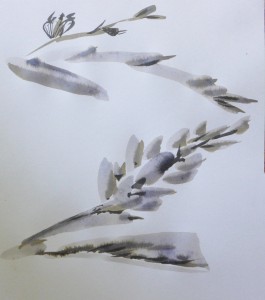
RED CANNA AND RED GINGER Nos. 1-3. November 24, 2015.
Made with a brush and quink on board, 8.5″ x 11″
Eventually, I attempted to copy objects in order to deploy the lines I have been exercising. However, these exercises involve not only lines but also light and dark lines. Although these lines are derived from the line exercises, it doesn’t seem enough. I need to practise the lines more.
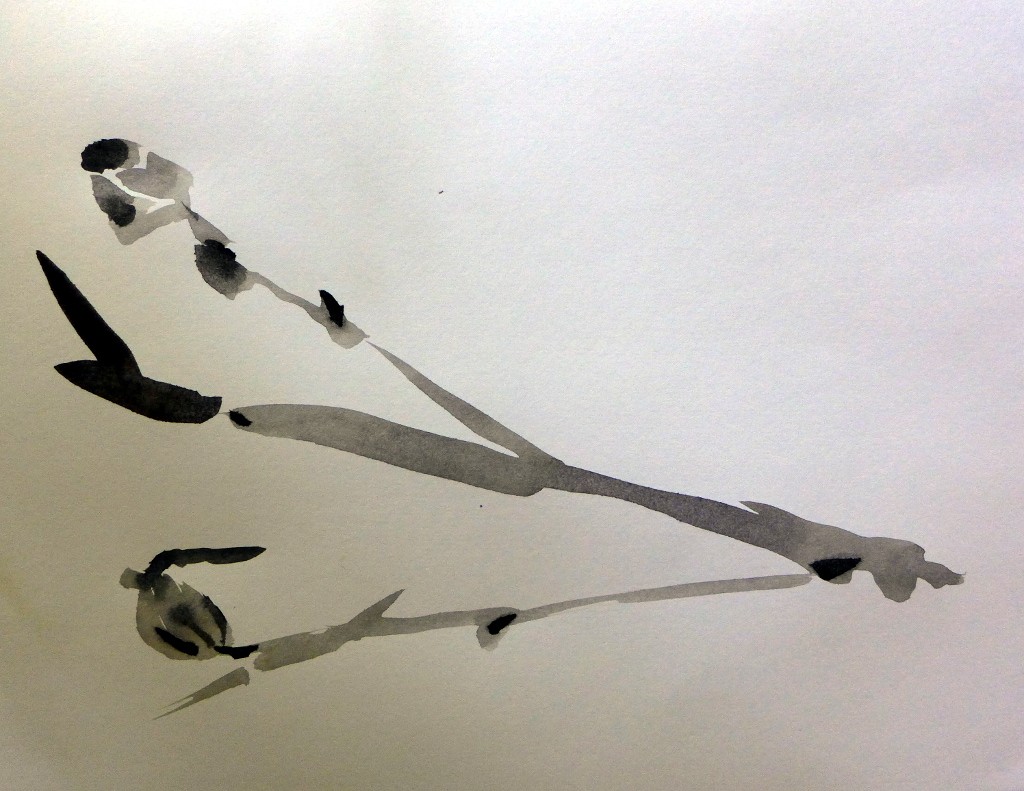
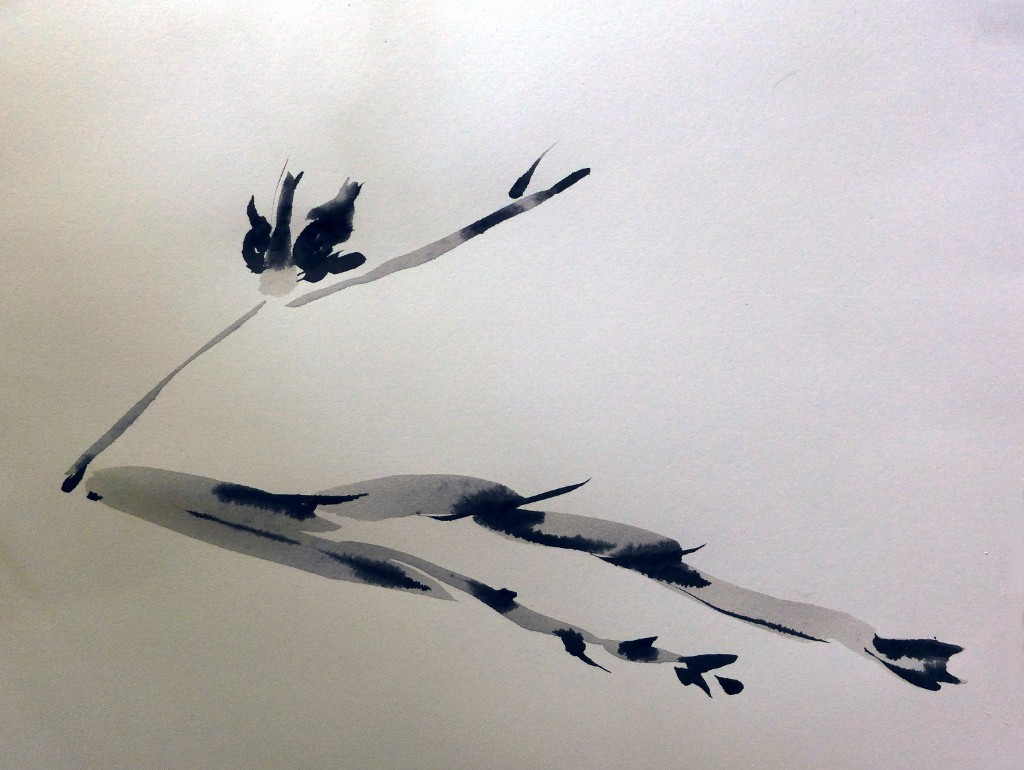
RED GINGER Nos. 1-5. November 25, 2015.
Made with a brush and quink/distemper on board, 8.5″ x 11″
Here, the strokes in the direction opposed to my dominant hand look better than those towards the right. I am most comfortable with the third painting because I wasn’t copying anything but rather just derived a basic set of strokes (rules) from the first two copying practise. I really need much more practise. I can’t copy an object without making good lines first. I thought that if I copied an object that would be a lesson in making lines, but it seems at least for me, that it is better to focus on making the line than on the looking. This was why my lines (and figures) looked better when I stopped looking at the object and simply ‘memorised’ it. Overall, I am not happy with these (technique-wise) and so I will need to make better lines.

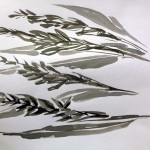
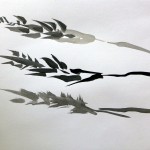
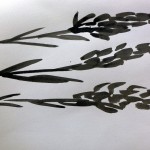
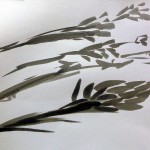
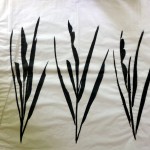
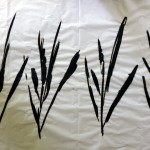
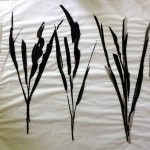
Made with a brush and distemper on Japanese paper, 20″ x 30″
After making horizontal lines today, I tried the making the leaves of the red ginger. I didn’t try to paint the flowers, just the leaves, so as not to make things too complicated.

5 replies on “Figurative Exercises”
All “red canna” exercises, the Nº1, 2 and 3 of “red ginger” and “red ginger leaves” are simply … beautiful. They are very authentic; It seems they were made in a glance…
Thank you Celino, it seems that making these lines is greatly affected by emotional state. It would be interesting to see how the lines are different when I am angry, for example. And yes, “at a glance” because the strokes must be made without hesitation. Greetings, Fatima
That is a big question. Can artist be a “professional” and act independently of his/her emotional state or not?
Probably it depends on the individual. For example, in theatre some actors/actresses claim that when they had to act in bad periods of their lives, they might do it; others probably could not. To me it does not shock me that an artist is a sort of pretender and a “professional of art” that is able to disguise his/her emotional state, preventing it manifests on his/her works. It is very difficult but in the limit it is possible. It is a challenge similar to those oriental techniques that try to put the mind in a superior level and separate it from the body, as if sensations could not affect the mind.
This is where art is indeed artifice. Methods, techniques, need to be developed by the artist in order to harness the state of mind and body. This demands an ability to be independent of those states, even for a moment.
I produce the largest number of poetry during times of disorder. This is a therapeutic not because it is catharsis, but because by concentrating on the form of the poem, the emotional state of mind is exploited. But once the emotions that drive the art is finished, what to do? Yet another technique, method, must be made. Again, for me, the role of formal art is the key. This is perhaps similar to what you say “to put the mind in superior level.”
And now that you mention it, meditation is perhaps part of formalism in art!
Precisely. And now you are raising another issue, Fatima. Is art the result of emotions or can it also be the cure for emotions? Anyway, I leave here my translation of the first stanza of a poem by Fernando Pessoa (one of the best portuguese poets). (I hope my poor English and memory do not betray me):
“The poet is a pretender.
He pretends so perfectly
that he even pretends to be pain
the pain he is truly feeling”